One of the most common questions people ask after practicing Yoga Nidra for the first time is:
“How can simply lying down and listening feel so deeply restorative?”
Some people finish a session feeling as though they have slept for hours. Others notice a profound sense of calm, mental clarity, or physical relaxation. Many describe the experience as existing somewhere between waking and sleeping, yet not fully belonging to either state.
This naturally leads to an important question: how does yoga nidra work?
The answer is both ancient and modern.
Traditional yogic teachings have long described Yoga Nidra as a state of conscious rest, where the body relaxes deeply while awareness remains present. Modern research has begun exploring how this practice influences the nervous system, brain activity, stress response, and recovery processes.
Although researchers continue to investigate, both traditional wisdom and contemporary science point toward a similar understanding: when the body and mind are given an opportunity to enter deep relaxation safely and consciously, powerful restorative processes can occur.
This article explores what happens during yoga nidra meditation, why it feels so restorative, and how ancient yogic understanding and modern science often describe the same experience using different language.
What Happens During Yoga Nidra?
From the outside, very little appears to happen during a Yoga Nidra practice.
You lie down. You close your eyes. You listen.
Yet internally, a gradual and systematic process begins.
A traditional yoga nidra meditation practice follows a structured sequence designed to guide awareness inward while allowing the body to relax completely. Although different teachers use slightly different approaches, the overall experience remains remarkably consistent.
If you are curious about how these practices are traditionally structured, exploring a Yoga Nidra Script can help illustrate the sequence of awareness, relaxation, and conscious rest used during a typical session.
The Body Becomes Still
The practice usually begins in Shavasana, lying comfortably on the back.
As movement decreases, the body receives an important message: for now, nothing needs to be done. Physical effort gradually disappears, creating the conditions for deeper relaxation.
Awareness Follows the Guidance
Attention is then directed through different parts of the body in a specific sequence.
Traditional teachings refer to this process as the rotation of consciousness. Rather than allowing the mind to wander through habitual patterns of thinking, awareness is gently guided from one point to another.
Physical Tension Begins to Release
As awareness moves through the body, muscles often begin to relax naturally.
Traditional yogic teachings understood this process as a gradual withdrawal of awareness from external activity. Modern physiology might describe it as a shift toward physiological restoration and reduced nervous system arousal.
Mental Activity Gradually Slows
Thoughts rarely disappear completely.
Instead, many practitioners notice that thoughts become quieter, less urgent, and less emotionally charged. Attention gradually moves away from planning, worrying, and reacting.
Awareness Remains Present
This may be the most distinctive aspect of the practice.
Although the body enters profound relaxation, awareness often remains partially present. Traditional yoga describes this as a state of conscious rest, a condition existing between ordinary waking and sleep.
This unique combination of relaxation and awareness may help explain why the practice feels so deeply restorative.
How Yoga Nidra Affects the Nervous System
Traditional yogic practitioners recognized something important thousands of years ago: the body and mind cannot be separated.
One of the reasons Yoga Nidra feels so restorative is that it works through the body to influence the mind.
In traditional practice, awareness systematically moves through different regions of the body in a precise sequence. This process may appear simple, yet traditional teachings understood it as a powerful method for gradually withdrawing awareness from external activity and directing it inward.
Interestingly, modern neuroscience offers an explanation that aligns remarkably well with these observations.
Researchers have demonstrated that every part of the body is represented within the sensory and motor regions of the brain. Some areas, particularly the hands, fingers, lips, and face, occupy disproportionately large regions of this sensory map. These same regions receive particular attention during traditional Yoga Nidra practices.
Rather than attempting to relax the mind directly, the practice begins by relaxing the body.
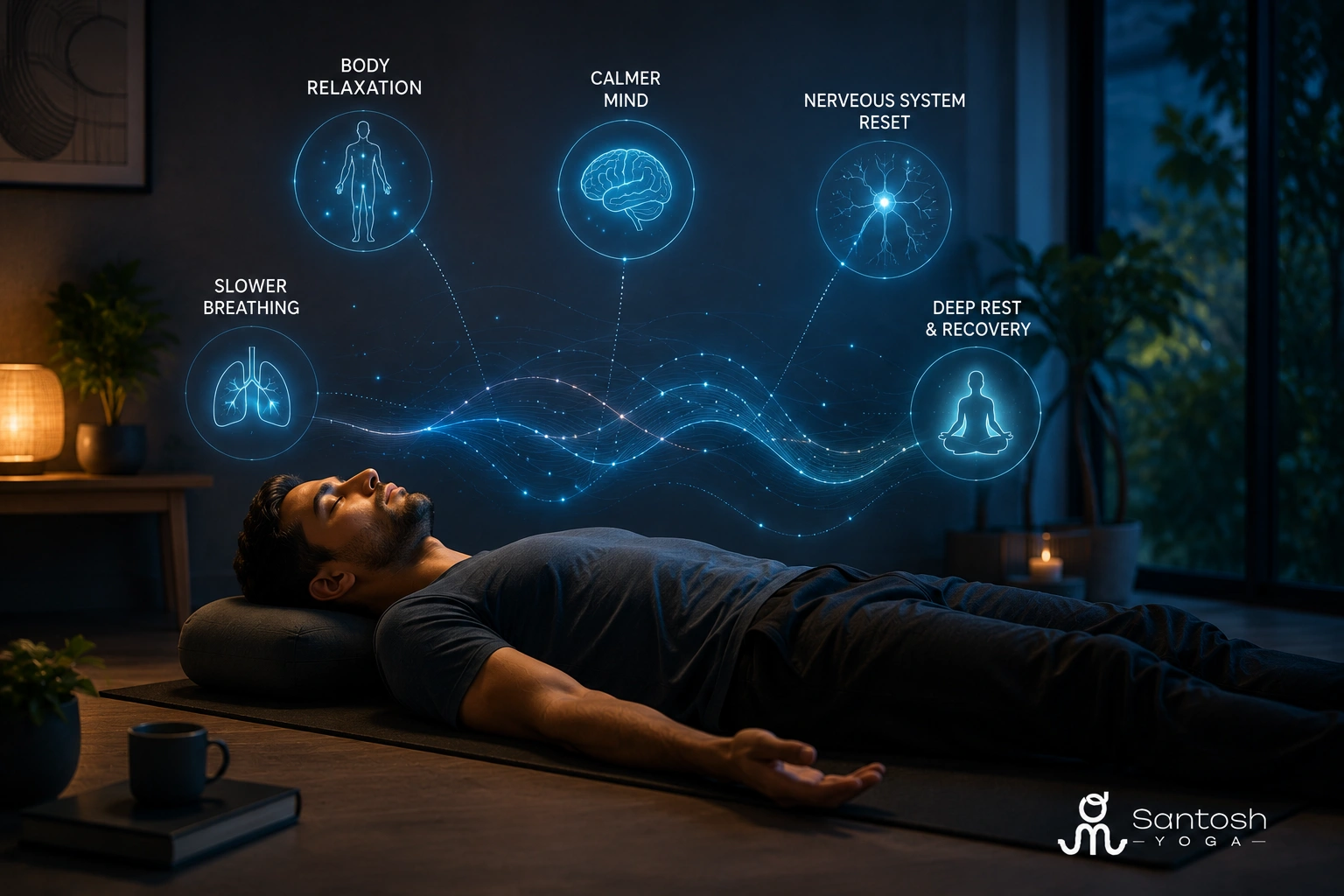
As awareness moves through different parts of the body:
- Physical tension gradually decreases
- Breathing naturally slows
- Sensory stimulation becomes less dominant
- Mental activity begins to quieten
- The body shifts toward restoration
Traditional yogic teachings describe this process as pratyahara, the withdrawal of awareness from external sensory experience.
Modern physiology describes a similar process through the lens of the parasympathetic nervous system, often called rest and digest response.
As this system becomes more active:
- Heart rate may decrease
- Muscle tension reduces
- Breathing becomes slower
- Stress physiology begins to settle
- Recovery processes become more accessible
This matters because many people today spend much of their lives in a state of chronic activation.
Work pressures, emotional stress, poor sleep, and constant stimulation can keep the stress response active far longer than it was designed to remain active.
Yoga Nidra offers a different experience.
Instead of preparing the body for action, it creates conditions that support safety, restoration, and recovery.
How Yoga Nidra Slows the Stress Response
Modern life asks a great deal of the nervous system.
Even when no immediate danger exists, many people experience the physiological effects of chronic stress: increased mental activity, muscular tension, emotional reactivity, and difficulty relaxing.
Traditional yogic teachings recognized this pattern long before modern stress physiology emerged.
Yoga Nidra appears to promote what researchers now call the relaxation response which is a physiological state that functions as the opposite of the well-known “fight or flight” response.
When the fight-or-flight response becomes activated:
- Heart rate increases
- Stress hormones rise
- Muscles become tense
- Attention narrows
- The body prepares for immediate action
While this response is essential for survival, problems arise when it remains activated continuously.
Research investigating yoga nidra science has explored changes in physiological markers associated with stress, including heart rate, blood pressure, cortisol, and autonomic nervous system activity.
Traditional yogic teachings describe the same process differently: by withdrawing awareness from constant sensory engagement and allowing deep relaxation to emerge, the body naturally shifts toward restoration.
This may help explain why so many practitioners report feeling calmer, clearer, and more emotionally balanced following regular practice.
For many people, one of the greatest benefits of Yoga Nidra may simply be the opportunity to experience what true relaxation feels like again.
Brain Waves and Deep Relaxation
One of the most fascinating aspects of how yoga nidra works is that traditional yogic descriptions of consciousness often closely resemble what modern neuroscience has observed through the study of brain waves.
Our brains produce different patterns of electrical activity depending on our state of awareness. Although science can become complex, the basic idea is relatively simple.
Beta Waves: Everyday Thinking
During normal waking life, the brain is predominantly active in what researchers call the beta state.
This is the state associated with:
- Active thinking
- Planning and decision-making
- Problem-solving
- External awareness
- Mental activity and concentration
Most of us spend the majority of our day in this state.
Alpha Waves: Relaxation and Calm Awareness
As the body begins to relax and external stimulation decreases, brain activity often shifts toward alpha waves.
Alpha activity is associated with:
- Physical relaxation
- Reduced muscular tension
- Quiet awareness
- Calm attention
- Reduced physiological arousal
Traditional yogic teachings have long regarded this state as particularly important because it represents a transition from doing to simply being.
Theta Waves: Deep Internal Experience
As relaxation deepens further, periods of theta wave activity may emerge.
Theta waves are commonly associated with:
- Dreaming
- Deep internal awareness
- Memory processing
- Creative imagery
- Emotional release
Traditional Yoga Nidra practices have long utilized imagery, visualization, and awareness practices that appear to engage this level of consciousness.
What Makes Yoga Nidra Different?
What makes Yoga Nidra particularly interesting is that it appears to prolong a transitional state that most people experience only briefly before falling asleep.
Psychologists call this the hypnagogic state, the threshold between wakefulness and sleep.
During ordinary sleep, this transition typically lasts only a few minutes.
During Yoga Nidra, however, practitioners learn to remain aware while the body enters increasingly profound states of relaxation. Research suggests that during practice, periods of alpha activity may alternate with both beta and theta rhythms, allowing awareness to remain poised between wakefulness and sleep for a prolonged period.
Traditional yogic teachings described this state thousands of years ago.
Modern neuroscience simply uses different language to describe it.
This may help explain why so many people feel deeply restored after a practice. Rather than moving directly from activity into unconscious sleep, Yoga Nidra creates an intermediate state of profound relaxation that many people rarely experience in everyday life.
Why Yoga Nidra Feels Like Sleep But Is Not Sleep
One of the most common experiences during Yoga Nidra is wondering:
“Was I asleep, or was I awake?”
The answer is often: a little of both.
This is why traditional teachings refer to the practice as yogic sleep. If you would like a broader introduction to its history, philosophy, and practice, our guide on What Is Yoga Nidra explores these foundations in greater depth.
Ordinary sleep is characterized by the loss of conscious awareness. During sleep, awareness gradually withdraws from the senses and turns inward automatically.
Yoga Nidra follows a similar pathway, but with one important difference:
Awareness remains present.
This creates a unique experience:
- The body becomes deeply relaxed.
- External awareness decreases.
- Mental activity slows.
- The senses gradually withdraw.
- Yet some degree of awareness remains.
This may explain why many practitioners feel as though they have slept, despite remembering portions of the practice afterward.
Traditional yogic teachings have long regarded this state as particularly valuable because it allows practitioners to experience profound relaxation while maintaining awareness.
Modern researchers have made a similar observation.
Many people move directly from the mental activity of waking life into sleep without passing through a prolonged state of deep relaxation. Yoga Nidra appears to create this missing stage, a period of profound physical and mental relaxation before deeper sleep processes occur.
Swami Satyananda Saraswati described this distinction beautifully:
Yoga Nidra is not simply sleep. It is “sleep after throwing off the burdens” , the experience of complete relaxation.
Perhaps this is why a 30-minute practice can sometimes leave people feeling more refreshed than several hours of restless sleep.
How Yoga Nidra Supports Sleep and Recovery
One of the reasons Yoga Nidra has gained so much attention in recent years is that people often notice benefits that extend far beyond the practice itself.
They may begin practicing to relax, sleep better, or manage stress, yet over time they often report improvements in recovery, emotional balance, energy levels, and overall well-being.
Traditional yogic teachings have long understood this.
The purpose of Yoga Nidra was never simply to help people relax. Rather, it was designed to create conditions in which the body and mind could return to a state of balance.
Supporting Better Sleep
Many people who struggle with sleep discover that the problem is not a lack of tiredness, but an inability to let go.
The body may be exhausted, but the mind remains active. Thoughts continue, muscles remain tense, and the nervous system behaves as though it still needs to remain alert.
This may help explain why so many people explore yoga nidra for sleep.
By encouraging deep physical relaxation and reducing mental overstimulation, the practice creates conditions that support the natural transition into sleep. Rather than forcing sleep, it allows the body to rediscover its own capacity for rest.
Research exploring Yoga Nidra and sleep continues to evolve, but many practitioners report improvements in sleep quality, reduced restlessness, and greater feelings of restoration following regular practice.
Supporting Recovery From Stress and Burnout
Traditional yogic teachings recognized that human beings cannot remain in a state of continuous activity indefinitely.
Periods of stress, emotional strain, poor sleep, and overwork eventually create imbalances that affect both body and mind.
Yoga Nidra offers something increasingly rare in modern life: an opportunity for deliberate, structured recovery.
Through deep relaxation and reduced physiological arousal, the practice may support:
- Physical recovery
- Emotional regulation
- Reduced feelings of overwhelm
- Improved resilience
- Greater psychological well-being
- Enhanced nervous system recovery
This may help explain why so many people experiencing fatigue, emotional exhaustion, or burnout find the practice particularly supportive.
Our guide on Yoga Nidra for Burnout explores how conscious rest practices may support recovery during periods of prolonged stress.
The Nervous System Learns Safety
Perhaps one of the most interesting ideas emerging from both traditional teachings and modern neuroscience is that the nervous system can learn patterns of safety and restoration.
When the body repeatedly experiences states of deep relaxation, it may become easier to access those states again in everyday life.
Traditional yogic teachings described this process differently.
Rather than viewing Yoga Nidra as a technique performed occasionally, they understood it as a practice that gradually transforms the relation between stress, rest, and awareness itself.
This may be one of the most important benefits of all.
The practice does not simply help us recover from stress.
It helps us remember what it feels like not to live inside it.
Why Consistency Matters
Many people notice the effects of Yoga Nidra after a single practice.
They may feel calmer, more rested, or more mentally clear. Yet traditional yogic teachings have always emphasized that the deeper effects of the practice emerge through repetition.
This is true of most forms of learning.
We do not become physically stronger through a single exercise session, nor do we develop emotional resilience through a single experience of relaxation.
The same principle applies here.
With regular practice, several things may begin to happen:
- The body learns to relax more easily.
- The transition into rest becomes more familiar.
- Mental reactivity may decrease.
- Sleep and recovery patterns may gradually improve.
- Awareness becomes easier to maintain during relaxation.
- The nervous system becomes more familiar with states of safety and restoration.
Traditional yogic texts describe this process as gradually reducing the habitual patterns that keep the mind in a state of constant activity.
Modern researchers might describe it as repeated exposure to states of deep relaxation and autonomic regulation.
Different languages.
Similar observation.
For most people, consistency matters more than duration.
A short practice several times each week is often more beneficial than an occasional long session.
Ultimately, the power of Yoga Nidra may not lie in any single experience.
Its real value emerges when deep rest becomes not an occasional event, but a familiar part of everyday life.
Experience Traditional Yoga Nidra for Deep Rest and Recovery
If you would like to experience how traditional Yoga Nidra supports deep relaxation, nervous system recovery, and long-term well-being, I invite you to explore our 45-minute Yoga Nidra for Longevity session.
Rooted in traditional yogic principles and informed by contemporary understanding of stress, sleep, and recovery, this guided experience is designed to help you move beyond simple relaxation and experience the restorative potential of conscious rest.
Whether you are seeking better sleep, support during periods of stress, recovery from burnout, or simply a deeper connection with rest itself, this practice offers a gentle place to begin.
Explore Yoga Nidra for Longevity and begin your practice today.
Frequently Asked Questions
How does Yoga Nidra work exactly?
Yoga Nidra works by guiding the body and mind into a state of deep relaxation while maintaining a degree of awareness. Traditional yogic teachings describe this as pratyahara, or withdrawal of the senses, while modern research explores it through concepts such as the relaxation response, brain wave changes, and nervous system regulation.
What happens in the brain during Yoga Nidra?
Research suggests that during Yoga Nidra, brain activity may shift from active beta waves toward more relaxed alpha and theta states. This transition is associated with reduced mental activity, relaxation, and altered states of awareness.
Is Yoga Nidra scientifically proven?
Studies have explored its effects on stress, sleep quality, physiological relaxation, and emotional well-being. While many findings are encouraging, researchers continue to investigate the mechanisms involved.
Does Yoga Nidra activate the parasympathetic nervous system?
Current evidence suggests that Yoga Nidra may support increased parasympathetic activity—the branch of the nervous system associated with rest, recovery, and restoration.
Why does Yoga Nidra feel like sleep?
Yoga Nidra occurs in a state between ordinary wakefulness and sleep. The body relaxes deeply while awareness remains partially present, which is why many people feel as though they have slept even when they remain aware throughout the practice.
Can Yoga Nidra improve recovery?
Many practitioners use Yoga Nidra to support recovery from stress, poor sleep, physical fatigue, and emotional exhaustion. One of the central highlights is its ability to create conditions that support rest and restoration.
How often should I practice Yoga Nidra?
Consistency generally matters more than duration. Many people find that practicing several times per week produces greater benefits than occasional longer sessions.
Is it normal to fall asleep during Yoga Nidra?
Yes. Falling asleep is common, especially for beginners or individuals experiencing fatigue. Traditional practice encourages maintaining awareness, but occasional sleep is considered a natural part of the learning process.
Conclusion
So, how does yoga nidra work?
Traditional yogic teachings would say that the practice works by gradually withdrawing awareness from external activity, allowing the body and mind to return to a state of balance and deep rest.
Modern science uses different languages. It describes changes in brain wave activity, nervous system regulation, stress physiology, and the innate capacity of the body for recovery.
Yet despite these different explanations, both perspectives arrive at a remarkably similar conclusion:
When the body is given an opportunity to feel safe enough to relax deeply, profound restoration can occur.
This may explain why Yoga Nidra continues to resonate so strongly in modern life. It offers something many people rarely experience: the opportunity to rest consciously, recover fully, and reconnect with a deeper sense of balance.
If you would like to experience this for yourself, I invite you to begin with a guided practice and discover what becomes possible when deep rest becomes part of everyday life.