One of the most common questions people ask is whether Yoga Nidra and meditation are actually the same practice.
The confusion is understandable. Both involve stillness, awareness, and stepping away from the constant activity of everyday life. Both have roots in ancient contemplative traditions. And both can support greater calm, clarity, and well-being.
Yet when we look more closely, the experience and purpose of these practices can feel quite different.
Some people find that traditional meditation helps them develop greater awareness and mental clarity. Others discover that sitting quietly with their thoughts feels difficult, especially during periods of stress, exhaustion, or poor sleep. For many of these individuals, yoga nidra meditation offers a different approach, one based not on effort or concentration, but on conscious relaxation and deep rest.
The question, then, is not necessarily which practice is better.
A more helpful question might be: what do you need right now?
Are you looking for greater awareness, emotional balance, better sleep, nervous system recovery, or simply an opportunity to rest deeply? Understanding the differences between these practices can help you choose the approach that best supports your current needs.
What Is Yoga Nidra?
Yoga Nidra is often translated as “yogic sleep,” although the practice is not actually sleep.
Traditionally, it is understood as a practice of conscious deep rest in which the body relaxes profoundly while awareness remains gently present. Most sessions are practiced lying down and follow a structured sequence involving body awareness, breath awareness, sensations, and observation of inner experience.
Unlike many forms of meditation, Yoga Nidra does not require intense concentration, control of thoughts, or sustained mental effort. Instead, the practice gradually guides the body and mind toward a state of deep relaxation.
This may be one reason why so many people find the practice accessible. Rather than asking us to do more, it invites us to let go of effort.
Today, many people practice yoga nidra meditation for stress relief, sleep support, recovery, and overall well-being, while traditional yogic teachings continue to regard it as a practice of awareness and conscious rest.
If you would like a deeper introduction to its history, philosophy, and traditional practice, you can read our guide on What Is Yoga Nidra.
What Is Meditation?
Meditation is a broad term used to describe practices that cultivate awareness, attention, and observation.
There is no single way to meditate. Some meditation practices focus on the breath, others on bodily sensations, compassion, visualization, or simply observing thoughts as they arise and pass.
In many traditional meditation practices, the practitioner sits upright and intentionally directs attention toward a chosen object of awareness. Whenever the mind wanders, attention is gently brought back.
Unlike Yoga Nidra, which emphasizes conscious relaxation, meditation often emphasizes conscious observation.
This distinction is important.
A common misconception is that meditation requires stopping thoughts altogether. In reality, meditation is less about eliminating thoughts and more about changing our relationship with them.
Both practices cultivate awareness.
They simply approach it from different directions.
Yoga Nidra vs Meditation: Key Differences
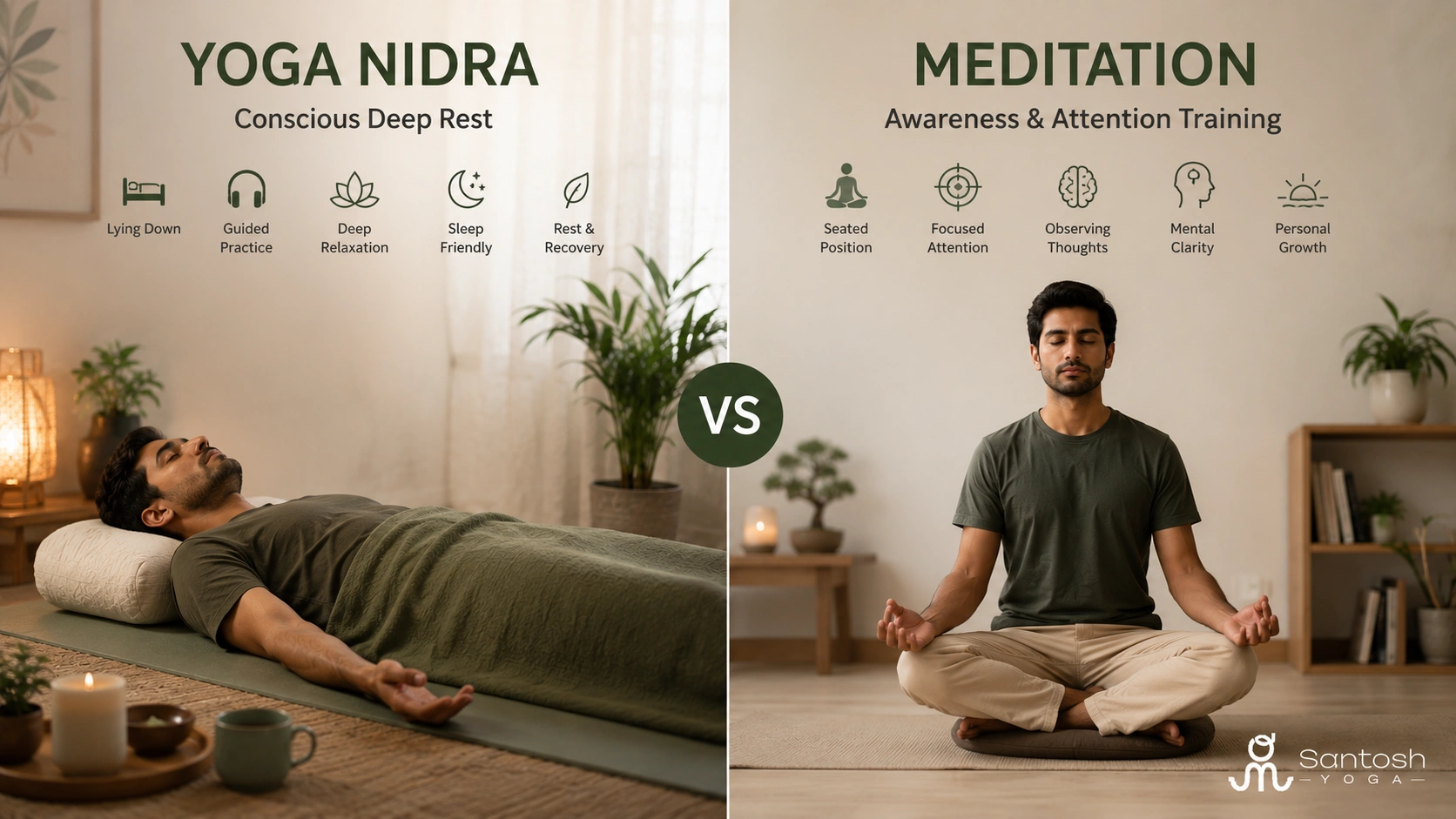
Although Yoga Nidra and meditation share certain qualities: stillness, awareness, and introspection, the experience of practicing them can feel very different.
The easiest way to understand the distinction is to think about their primary intention.
Traditional meditation practices generally cultivate awareness through attention. Yoga Nidra cultivates awareness through relaxation.
Neither approach is inherently better than the other. Rather, they support different aspects of well-being and consciousness.
| Feature | Yoga Nidra | Meditation |
| Body Position | Lying Down | Usually Seated |
| Guidance | Guided | Guided or Self Directed |
| Effort Level | Passive | More Active |
| Primary Goal | Deep Rest and Conscious Relaxation | Awareness and Attention Training |
| Sleep Friendly | High | Moderate |
| Physical Demand | Minimal | Minimal to Moderate |
| Mental Approach | Letting Go | Observing and Returning Attention |
Body Position
One of the most noticeable differences is posture.
Traditional meditation is commonly practiced sitting upright with an alert but relaxed posture. Yoga Nidra, by contrast, is usually practiced lying down in Shavasana, allowing the body to release physical effort almost completely.
For many people, especially those experiencing stress, fatigue, or burnout, this alone can make the practice feel more accessible.
Effort and Attention
Most meditation practices require some degree of active participation. You may focus on the breath, observe thoughts, repeat a mantra, or repeatedly bring attention back to the present moment.
Yoga Nidra asks for something different.
Instead of actively directing attention, you follow a guided sequence and allow awareness to move naturally through the body, breath, sensations, and inner experience. The emphasis is on allowing rather than doing.
Deep Rest Versus Awareness Training
Meditation is often described as an awareness practice. Over time, it may help cultivate attention, emotional balance, and greater insight into the workings of the mind.
Yoga Nidra also cultivates awareness, but it does so through deep rest, conscious relaxation, and nervous system recovery.
Traditional yogic teachings have long recognized that awareness can emerge not only through concentration, but also through profound relaxation.
Which Practice Feels Easier?
There is no universal answer.
Some people feel comfortable sitting quietly and observing their thoughts. Others find this difficult, particularly during periods of stress, poor sleep, or emotional exhaustion.
This may help explain why many people who struggle with traditional meditation discover that guided meditation vs yoga nidra feels less like a comparison and more like a choice between two different paths toward the same destination: greater awareness and well-being.
Ultimately, the question is not whether one practice is superior.
The question is which practice supports what you need most right now.
Which Is Better for Sleep?
When it comes to sleep, traditional Yoga Nidra offers some unique advantages.
Many forms of meditation are designed to cultivate awareness, concentration, and a different relationship with thoughts. These qualities can certainly support overall well-being and may indirectly contribute to better sleep over time. However, for someone who is already tired, stressed, or struggling to switch off at night, meditation can sometimes feel like another activity that requires effort.
Yoga Nidra approaches sleep from a different perspective. The goal is not to force sleep, but to allow the body and mind to gradually move toward it.
Some of the ways Yoga Nidra may support sleep include:
- Encouraging physical relaxation throughout the body
- Helping reduce mental overstimulation before bedtime
- Supporting nervous system recovery
- Creating a gradual transition from wakefulness to rest
- Reducing the pressure often associated with trying to fall asleep
Traditional yogic teachings have long recognized that sleep cannot be forced. Instead, the body must be given an opportunity to relax deeply enough for sleep to arise naturally.
For this reason, many practitioners choose to use Yoga Nidra as part of their evening routine. Whether practiced before bed or during periods of stress and fatigue, it offers a structured form of guided relaxation that supports the body’s natural capacity for rest and recovery. Meditation may help cultivate awareness and mental clarity, while Yoga Nidra provides a more direct pathway to relaxation, restoration, and deep rest.
If better sleep is your primary goal, our guide on Yoga Nidra for Sleep explores how traditional practices can support bedtime relaxation, nervous system recovery, and restorative sleep.
Which Is Better for Stress and Recovery?
Both meditation and Yoga Nidra have long been used to support relaxation, emotional balance, and overall well-being. However, they often work through different pathways.
Traditional meditation practices typically help cultivate awareness, observation, and a different relationship with thoughts and emotions. Over time, this may support greater emotional resilience and mental clarity.
Yoga Nidra approaches stress and recovery from a different direction.
Many people experiencing stress, burnout, or mental fatigue do not necessarily need another technique that requires concentration. They need an opportunity to rest deeply enough for recovery to begin.
Modern research has increasingly explored how deep relaxation practices influence physiological markers associated with stress, including autonomic nervous system activity and stress hormone regulation.
Many of these effects reflect the broader benefits of Yoga Nidra, which extend beyond relaxation and may support sleep, recovery, emotional balance, and overall well-being.
While this research continues to evolve, these findings closely reflect what traditional yogic practitioners have observed for centuries: when the body enters a state of deep rest, restoration naturally follows.
That does not mean meditation is less valuable. Rather, the two practices often complement one another. Meditation can help cultivate awareness and insight while Yoga Nidra can help restore the energy and stability needed to sustain that awareness.
For many people, especially during periods of stress and recovery, deep rest becomes the foundation upon which everything else is built.
Who Should Choose Yoga Nidra?
While both meditation and Yoga Nidra offer valuable practices for cultivating well-being, there are certain situations in which Yoga Nidra may feel particularly supportive.
People Who Feel Mentally Exhausted
There are times when the mind feels so overloaded that even the idea of “focusing” becomes tiring.
During these periods, practices that require concentration or sustained attention may feel difficult. Because Yoga Nidra is based on guided awareness and relaxation, it can provide a gentler entry point into restorative practices.
People Struggling With Sleep
When sleep becomes difficult, many people begin trying harder to relax, only to become more frustrated.
Rather than attempting to force sleep,Yoga Nidra encourages the body and mind to move gradually toward rest, making it particularly appealing for those seeking support with bedtime relaxation and recovery.
People Experiencing Burnout
Burnout often involves more than physical tiredness. It can bring feelings of emotional depletion, mental fatigue, and a reduced capacity to recover. In these situations, practices centered on restoration rather than effort may feel especially valuable.
The structured, supportive nature of Yoga Nidra allows practitioners to experience rest without needing to achieve anything. If exhaustion, mental fatigue, or emotional depletion are your primary concerns, our guide on Yoga Nidra for Burnout explores how conscious rest may support recovery and resilience.
People Who Find Seated Meditation Difficult
Some people experience physical discomfort while sitting. Others become frustrated when their minds continue to wander. Because Yoga Nidra is practiced lying down and follows a guided structure, many beginners find it easier to approach without feeling that they are “doing it wrong.”
People Seeking Deep Rest and Recovery
Perhaps the people who benefit most are those who have become accustomed to functioning without adequate rest.
Whether due to demanding work, caregiving responsibilities, emotional stress, or simply the pace of modern life, many individuals spend years in a state of continuous activity. For them, Yoga Nidra offers something that is increasingly rare: an opportunity to pause, recover, and reconnect with a deeper sense of balance.
Ultimately, choosing Yoga Nidra does not mean rejecting meditation.
It simply means recognizing that sometimes the first step toward greater awareness is allowing ourselves to rest.
Can You Practice Both?
Absolutely.
In fact, traditional yogic teachings have never viewed rest and awareness as opposing experiences. Rather, they are often understood as complementary aspects of practice.
Meditation and Yoga Nidra can support different needs at different times.
For example:
- Meditation may help cultivate attention, observation, and emotional clarity.
- Yoga Nidra may support deep rest, recovery, and nervous system regulation.
- Meditation can help develop awareness during activity.
- Yoga Nidra can help restore balance after periods of physical or mental exertion.
Many practitioners find that the two practices naturally complement one another.
A seated mindfulness practice in the morning may help create focus and presence throughout the day. A Yoga Nidra practice in the evening may help the body and mind transition into rest and recovery. For those interested in understanding how a traditional practice is structured, exploring a Yoga Nidra Script can offer insight into the sequence of awareness, relaxation, and conscious rest used during practice sessions.
The question is not whether yoga nidra vs mindfulness or meditation is superior.
The more useful question is what your body and mind need at a particular moment.
There may be periods of life when meditation feels deeply supportive. There may be other times like, during stress, burnout, poor sleep, or emotional exhaustion, when practising restoration might feel more appropriate and helpful.
Traditional yoga has always recognized that human beings require both awareness and recovery.
Meditation helps us cultivate awareness.
Yoga Nidra reminds us that awareness also requires rest.
For many people, this is not a choice between two practices, but a conversation between two complementary ways of caring for the mind, body, and nervous system.
Experience Traditional Yoga Nidra for Deep Rest and Recovery
If you would like to experience how traditional Yoga Nidra can support deep rest, emotional balance, recovery, and long-term well-being, I invite you to explore our 45-minute Yoga Nidra for Longevity session.
Rooted in traditional yogic principles and shaped by decades of practice and teaching, this guided experience is designed to help you step away from constant activity and rediscover the restorative power of conscious rest.
Whether you are seeking better sleep, greater resilience, support during periods of stress, or simply a deeper connection with rest itself, this practice offers a gentle place to begin.
Explore Yoga Nidra for Longevity and begin your practice today.
Frequently Asked Questions
Is Yoga Nidra the same as meditation?
Not exactly. Both practices cultivate awareness, but they approach it differently. Meditation often emphasizes observation and attention, while Yoga Nidra emphasizes conscious relaxation and deep rest.
Which is better for sleep?
For many people, Yoga Nidra may feel more accessible before bedtime because it encourages relaxation rather than concentration. This is one reason why so many people practice it for sleep support and recovery.
Is Yoga Nidra easier for beginners?
Many beginners find Yoga Nidra easier to approach because it is practiced lying down and follows a guided structure. No previous meditation or yoga experience is required.
Can I practice both meditation and Yoga Nidra?
Absolutely. The two practices often complement one another. Meditation can support awareness and mental clarity, while Yoga Nidra can support recovery, restoration, and relaxation.
Does Yoga Nidra count as meditation?
Many teachers and traditions consider Yoga Nidra to be a form of meditative practice. However, its emphasis on guided relaxation and conscious rest gives it a unique character.
Which practice is better for stress?
Both practices can support emotional well-being. Meditation may help cultivate awareness and perspective, while Yoga Nidra may offer more immediate support for relaxation and nervous system recovery.
Can Yoga Nidra replace meditation?
Not necessarily. For some people, Yoga Nidra becomes their primary contemplative practice. Others find that it complements a regular meditation practice by providing opportunities for deeper rest and restoration.
Do I need to stop my thoughts during either practice?
No. Neither meditation nor Yoga Nidra requires eliminating thoughts. Both practices encourage developing a different relationship with mental activity rather than trying to force the mind to become quiet.
Conclusion
The question of yoga nidra vs meditation ultimately has no universal answer.
Both practices offer valuable and time-tested approaches to cultivating greater well-being, awareness, and balance. Meditation can help us develop attention, observation, and insight. Yoga Nidra offers an opportunity for deep restoration, conscious relaxation, and nervous system recovery.
The choice depends less on which practice is “better” and more on what you need at a particular stage of life.
There may be times when cultivating awareness feels most important.
There may be other times when what you need most is permission to rest.
Perhaps this is one of the enduring strengths of traditional yoga: the recognition that human beings require both.
If you are curious about exploring conscious rest for yourself, I invite you to begin with a guided practice and discover what becomes possible when awareness is supported by deep relaxation.